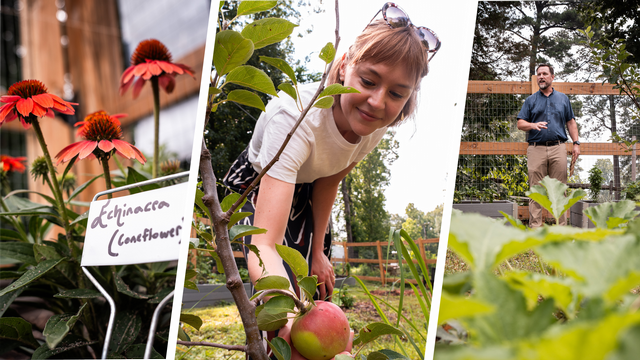
UR Orchard and Food Forest encourages Spider community to engage with nature
A generous gift from a Spider alumna and her family funded the creation of the Orchard and Food Forest.
February 5, 2026
What began as an idea has literally blossomed into reality.
This past fall, the Spider community celebrated the grand opening of the UR Orchard and Food Forest. Located next to Abby’s Garden in the Eco-Corridor (a multi-use recreational trail that connects campus with surrounding neighborhoods), the new space is open to the public and contains a variety of fruits, shrubs, vegetables, herbs, flowers, and plants.
Daniel Hart, associate director of sustainability and environmental justice, proposed the concept in 2022. Two years later, the Office for Sustainability received a generous unsolicited gift from the Oak Foundation at the direction of a Spider family. With encouragement from the foundation, the office used the funding to pursue Hart’s vision.
The orchard represents an ongoing collaboration across campus and with the greater Richmond community. Department of Geography, Environment, & Sustainability students selected trees and shrubs for the space and determined evaluation criteria to measure its success. Student volunteers from Alpha Sigma Kappa — Women in Technical Studies planted trees and installed planter boxes, which were built by University Facilities. Local high school students filled the boxes with soil and planted vegetation. The orchard also welcomes visitors from local nonprofit organizations, including the Blue Sky Fund, which connects Richmond youth with natural environments to promote outdoor education.
With more than 40 species of plants, the orchard will not only enhance biodiversity and increase tree canopy coverage on campus, but it will also provide opportunities for experiential education at UR, said Rob Andrejewski, director of sustainability.
“We call it a ‘living lab,’ and there are so many ways to learn and engage,” he said. “Students who returned from a study abroad to Oaxaca, Mexico, planted a Three Sisters Garden of beans, squash, and corn adjacent to the orchard in Abby’s Garden. I would love for a class studying, say, Italian films to make pizza with our fresh tomatoes and basil as part of a class movie night.”
Andrejewski also emphasized the mindfulness benefits of the space, citing a recent study by the Mayo Clinic on the power of nature for restoring attention span and boosting mood.
“We live in a hyper-focused, way too fast world, so it is critical to design accessible spaces where people can slow down, sit, and relax,” he said. “The orchard is a safe, welcoming place where both plants and people can thrive.”
This past fall, the Spider community celebrated the grand opening of the UR Orchard and Food Forest. Located next to Abby’s Garden in the Eco-Corridor (a multi-use recreational trail that connects campus with surrounding neighborhoods), the new space is open to the public and contains a variety of fruits, shrubs, vegetables, herbs, flowers, and plants.
Daniel Hart, associate director of sustainability and environmental justice, proposed the concept in 2022. Two years later, the Office for Sustainability received a generous unsolicited gift from the Oak Foundation at the direction of a Spider family. With encouragement from the foundation, the office used the funding to pursue Hart’s vision.
The orchard represents an ongoing collaboration across campus and with the greater Richmond community. Department of Geography, Environment, & Sustainability students selected trees and shrubs for the space and determined evaluation criteria to measure its success. Student volunteers from Alpha Sigma Kappa — Women in Technical Studies planted trees and installed planter boxes, which were built by University Facilities. Local high school students filled the boxes with soil and planted vegetation. The orchard also welcomes visitors from local nonprofit organizations, including the Blue Sky Fund, which connects Richmond youth with natural environments to promote outdoor education.
With more than 40 species of plants, the orchard will not only enhance biodiversity and increase tree canopy coverage on campus, but it will also provide opportunities for experiential education at UR, said Rob Andrejewski, director of sustainability.
“We call it a ‘living lab,’ and there are so many ways to learn and engage,” he said. “Students who returned from a study abroad to Oaxaca, Mexico, planted a Three Sisters Garden of beans, squash, and corn adjacent to the orchard in Abby’s Garden. I would love for a class studying, say, Italian films to make pizza with our fresh tomatoes and basil as part of a class movie night.”
Andrejewski also emphasized the mindfulness benefits of the space, citing a recent study by the Mayo Clinic on the power of nature for restoring attention span and boosting mood.
“We live in a hyper-focused, way too fast world, so it is critical to design accessible spaces where people can slow down, sit, and relax,” he said. “The orchard is a safe, welcoming place where both plants and people can thrive.”