Robotics lab prepares Richmond students for tech industry careers
Donor support of Patrick Martin’s robotics research is providing real-world experience and opportunities for computer science students.
May 12, 2026
In Patrick Martin’s robotics lab, students do more than make robots dance – they develop real-world tech experience that leads them to meaningful careers.
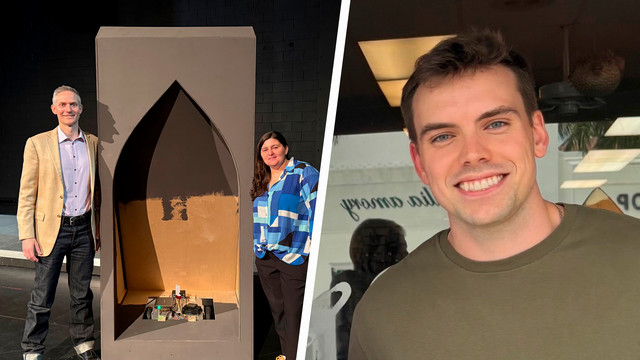
Martin, a computer science professor who specializes in autonomous mobile robotics and human-robot teaming, has used the lab as a research hub since coming to UR in 2023. Each year, he and a team of undergraduate students work to develop cutting-edge technologies that allow humans and robots to interact in more natural ways.
“Our focus is on humans and robots working together in close proximity,” Martin said. “We want robots to be out with people and make safe decisions in a real-time setting.”
Students can participate in the lab through independent study, but up until this past fall, they volunteered their time. Thanks to a generous donation, Martin can now hire dedicated student researchers to work in the lab eight to 10 hours a week for the entire school year.
“The students we get are very busy, often balancing academics with part-time work on or off campus,” Martin said. “It was hard for them to find a few extra hours to spend in the lab each week. Now, they don’t have to sacrifice their time – they can make money while focusing on their research and building skills in creativity and independent thinking.”
The donations are a gift from Jack Williams, who met Martin through his involvement with the Osher Lifelong Learning Institute. Williams has audited classes throughout the School of Arts & Sciences and said he is impressed with the school’s cross-disciplinary collaborations. A retired Shell Oil Co. executive and recruiter with decades of industry experience in engineering and computer science, Williams was particularly inspired by Martin’s research and his dedication to his students.
“I took one of Patrick’s classes and participated in his lab,” Williams said. “The value of what I learned is greater than the value of what I gave. I’m glad that I can help Patrick hire the best and brightest students to continue this important work.”
Recent graduate Will Gephart, ’26, worked in the lab during his senior year. He and Andrey Seabra, ’27, used Python programming language to revamp outdated software so that it could run on a variety of devices. Gephart leveraged this experience to secure a job as a software engineer at Ridgeline, a leading financial tech startup.
“My lab work was extremely relevant for the role,” he said. “Ridgeline typically doesn’t hire new college graduates, but they were impressed with my software development experience and saw a lot of overlap with what they do. Working with Dr. Martin was an amazing opportunity, and I’m very grateful and excited to start my tech career.”
Martin will continue to collaborate with student researchers this summer and during the school year as they work to advance the intersection of robotics and the performing arts, an ongoing focus of the lab over the last two years.
“We pride ourselves on doing work that is interdisciplinary and solves unique challenges that modern society is facing,” Martin said. “The donor support we receive directly translates into student impact – they develop incredible skills and go on to do great things.”
Martin, a computer science professor who specializes in autonomous mobile robotics and human-robot teaming, has used the lab as a research hub since coming to UR in 2023. Each year, he and a team of undergraduate students work to develop cutting-edge technologies that allow humans and robots to interact in more natural ways.
“Our focus is on humans and robots working together in close proximity,” Martin said. “We want robots to be out with people and make safe decisions in a real-time setting.”
Students can participate in the lab through independent study, but up until this past fall, they volunteered their time. Thanks to a generous donation, Martin can now hire dedicated student researchers to work in the lab eight to 10 hours a week for the entire school year.
“The students we get are very busy, often balancing academics with part-time work on or off campus,” Martin said. “It was hard for them to find a few extra hours to spend in the lab each week. Now, they don’t have to sacrifice their time – they can make money while focusing on their research and building skills in creativity and independent thinking.”
The donations are a gift from Jack Williams, who met Martin through his involvement with the Osher Lifelong Learning Institute. Williams has audited classes throughout the School of Arts & Sciences and said he is impressed with the school’s cross-disciplinary collaborations. A retired Shell Oil Co. executive and recruiter with decades of industry experience in engineering and computer science, Williams was particularly inspired by Martin’s research and his dedication to his students.
“I took one of Patrick’s classes and participated in his lab,” Williams said. “The value of what I learned is greater than the value of what I gave. I’m glad that I can help Patrick hire the best and brightest students to continue this important work.”
Recent graduate Will Gephart, ’26, worked in the lab during his senior year. He and Andrey Seabra, ’27, used Python programming language to revamp outdated software so that it could run on a variety of devices. Gephart leveraged this experience to secure a job as a software engineer at Ridgeline, a leading financial tech startup.
“My lab work was extremely relevant for the role,” he said. “Ridgeline typically doesn’t hire new college graduates, but they were impressed with my software development experience and saw a lot of overlap with what they do. Working with Dr. Martin was an amazing opportunity, and I’m very grateful and excited to start my tech career.”
Martin will continue to collaborate with student researchers this summer and during the school year as they work to advance the intersection of robotics and the performing arts, an ongoing focus of the lab over the last two years.
“We pride ourselves on doing work that is interdisciplinary and solves unique challenges that modern society is facing,” Martin said. “The donor support we receive directly translates into student impact – they develop incredible skills and go on to do great things.”